Why AI Search Is Making Real Video the Smarter SEO Buy
SEO is being repriced around AI, AEO, GEO, and video discovery. For business leaders, the smartest response is not always more AI-generated content. A focused live-action video shoot can create trusted, reusable assets that perform across search, sales, paid media, and AI answer engines.
The SEO market has not collapsed. It has become more selective, more senior, and more obsessed with proof. Recent job-market reports show fewer old-school content SEO roles and more demand for people who understand AI search, answer engines, data, UX, and commercial outcomes. In plain English, companies are asking SEO teams to do more than rank pages. They want them to help the brand get chosen.
That shift matters for video marketing because search is now deeply multimodal. People search with text, voice, images, video, social clips, product demos, reviews, and AI assistants. Google has been pushing AI Mode, AI Overviews, Lens, and richer visual discovery. Google Search Central still recommends giving video pages clear titles, thumbnails, structured data, and accessible context so search systems can understand them. The signal is obvious: brands need content that machines can parse and humans can believe.
The SEO Labor Market Is Telling Buyers Something
When SEO job descriptions start asking for AI fluency, AEO, GEO, analytics, video strategy, and conversion thinking, the market is not just chasing buzzwords. It is repricing the work. A person who used to publish keyword articles now has to understand how a brand becomes a credible answer inside AI-assisted search. That means expertise, originality, entity signals, citations, video evidence, brand mentions, and assets that feel legitimate outside the blog post.
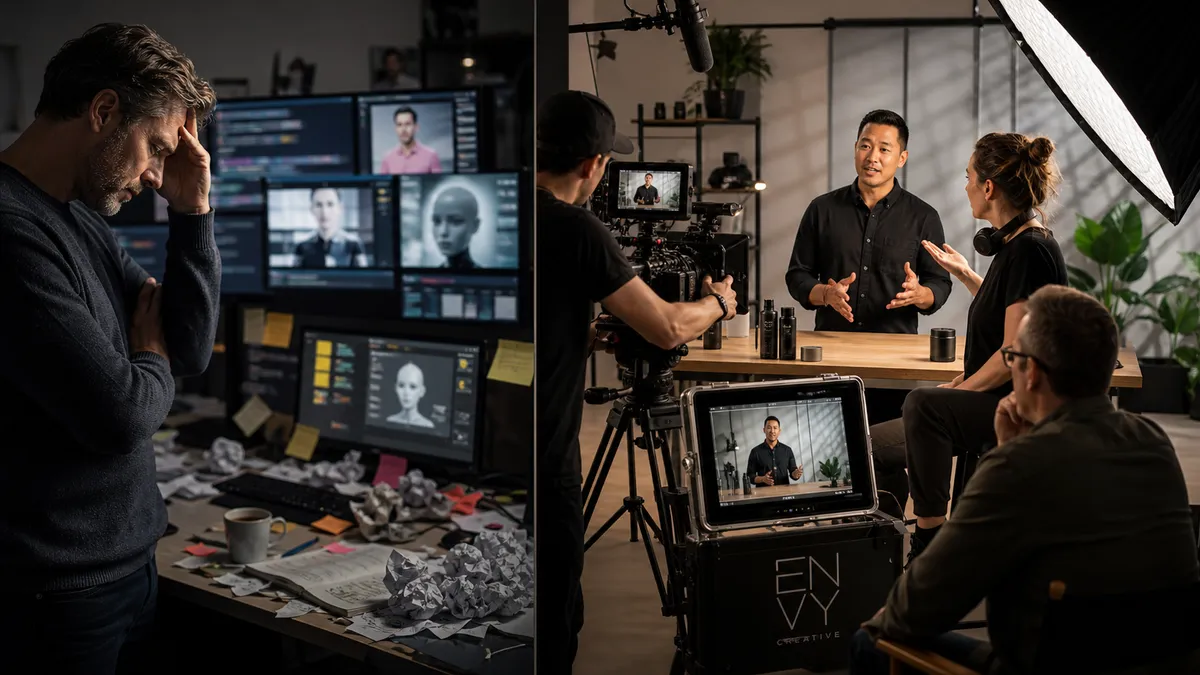
I have seen this play out in client conversations. A marketing lead comes in thinking the choice is simple: make a lot of AI video quickly or spend more on one real shoot. Then we map the assets. A single well-planned live-action production can create a hero video, short social edits, product clips, founder sound bites, testimonial pulls, YouTube assets, landing page media, sales enablement clips, paid ad variations, thumbnails, transcripts, and stills. Suddenly the cost comparison looks very different.
AI Video Looks Cheap Until the Brand Has to Use It
AI-generated video can be useful for concepting, rough storyboards, fast internal ideas, and certain low-risk creative experiments. It is not useless, and pretending it is would be silly. But for a business asking customers to trust a product, book a demo, invest in a service, or believe a leadership message, AI video often comes with hidden costs.
- Prompt and revision time: getting a usable clip can take more rounds than expected.
- Brand consistency issues: faces, products, uniforms, locations, and details can drift.
- Approval friction: legal, leadership, and product teams may be nervous about synthetic claims or invented visuals.
- Low proof value: an AI avatar cannot replace a real customer, founder, engineer, or product expert.
- Short shelf life: generic AI visuals age quickly because everyone can create a similar look.
That is where live-action video becomes more cost effective, not less. Real footage gives you evidence. You can show the actual people behind the company, the real product, the real process, the real customer environment, and the real stakes. AI search systems may summarize pages, but decision-makers still respond to credibility. A polished video of your team solving the problem is harder to commoditize than another generated explainer.
Search Engines Need Signals, Buyers Need Confidence
AEO and GEO are often explained as technical disciplines, but the creative takeaway is simple: answer the question better than the market, then package that answer in formats people and machines can use. A live-action video helps with both. It can sit on a service page with a transcript. It can become a YouTube description with chapters. It can support schema markup. It can give sales teams a cleaner follow-up asset. It can be clipped into paid social or embedded into a proposal.
For buyers comparing vendors, real video reduces doubt. They can see the founder’s conviction, the product’s texture, the customer’s reaction, the facility, the team, and the quality standard. That emotional information is difficult to fake well. It is also exactly what AI summaries cannot fully replace. AI can quote, summarize, and recommend, but it still needs strong source material to work from.
If your team is trying to build a smarter content engine around search, answer engines, and video discovery, Envy Creative can help you turn one focused production into custom video content that works across SEO, sales, paid media, and brand trust.
The Real Cost Equation Has Changed
Most teams compare AI video and live action at the wrong level. They compare one generated clip to one finished commercial. That misses the actual business question: what asset system will drive qualified attention for the next six to twelve months?
A real shoot has pre-production, crew, gear, direction, filming, editing, color, sound, and delivery. That sounds heavier than an AI tool subscription. But the output is also heavier in a good way. You get owned footage. You get authentic subject matter. You get reusable clips that can be versioned for Google Ads, LinkedIn, YouTube, landing pages, email, sales decks, webinars, recruitment, and customer education. You are not buying a single video. You are building a library of proof.
With AI video, the invoice may look smaller at first, but the usable output can be narrow. You may still need human strategy, scripting, editing, compliance review, brand review, platform formatting, performance testing, and a fallback plan when the generated visuals do not match the product or promise. For serious B2B marketing, those hidden costs matter.
What Makes Real Video Perform in AI Search
Real video works best when it is planned as a search asset from the start, not just a pretty film. That means the creative brief should include the questions customers ask, the proof points the sales team repeats, the objections that slow deals down, and the pages where the video will live. The shoot should capture direct answers, short modular statements, clean product moments, and human reactions that can be repurposed.
- Start with buyer questions: build segments around problems, comparisons, objections, and outcomes.
- Capture expert language: let founders, product leads, and customers say the phrases real buyers use.
- Plan for transcripts: search systems need context, not just a beautiful embed.
- Create short derivatives: one shoot should feed website video, social clips, ads, email, and sales outreach.
- Use real proof: show the product, process, team, environment, or customer result whenever possible.
Where AI Still Belongs in the Workflow
The strongest approach is not anti-AI. It is anti-waste. Use AI to accelerate research, outline questions, pressure-test hooks, summarize transcripts, create rough edit notes, and generate alternate ad copy. Use real production for the moments where trust is won. That balance gives you speed without sacrificing believability.
In my experience, the best shoots now feel more strategic than they did five years ago. We are not just asking what looks good. We are asking what search systems can understand, what sales teams can reuse, what paid media can test, and what a skeptical buyer needs to see before raising a hand.
The Buyer Takeaway
The SEO job market is quietly saying the same thing your customers are saying: generic content is worth less, credible expertise is worth more. AI has made average content easier to produce, which means average content has become easier to ignore. Real video gives your brand a defensible asset: people, proof, clarity, and production value that can support discovery wherever buyers are looking.
If you are weighing AI video against live-action production, do not ask which option is cheapest per clip. Ask which option gives your team the most useful evidence, the longest content runway, and the strongest chance of being trusted by both AI systems and human buyers. For many brands, that is a well-planned real shoot.
Ready to build video assets that do more than fill a content calendar? Talk with Envy Creative about custom video content built for search visibility, buyer confidence, and measurable marketing use.