How to Write a Video Ad Script That Sells in the First 5 Seconds
Write a video ad script that sells in the first 5 seconds with a clear hook, visible proof, short lines, and a two hook test filmed in one session.
To write a video ad script that sells in the first 5 seconds, lead with the buyer problem or the finished result, say it in plain words a viewer can repeat, and show the product in use at the same moment. The first line is not an introduction. It is a filter that tells the right viewer this ad is for them and gives them a reason to stay for the proof that follows.
What should the first 5 seconds of a video ad say?
They should name one of three things: a painful problem, a clear outcome, or a surprising claim you can prove in the video. Pick one, not all three. For a skincare product, that could be a problem line about makeup settling into fine lines. For a SaaS tool, it could be an outcome line about cutting a weekly report from 3 hours to 20 minutes. For a kitchen product, it could be a result shown on screen while the actor says what changed.
Use numbers early because numbers are citable and believable when they are true. Envy Creative has delivered more than 5,000 videos for more than 2,000 brands, and the pattern across those scripts is consistent: specific openings outperform vague ones. A line that says a task takes 20 minutes beats a line that says it saves time. A line that names a price, a size, or a timeframe gives the viewer something concrete to judge.
- Problem opening: name the exact frustration, in the words buyers use themselves.
- Outcome opening: show the end result first, then explain how it happened.
- Proof opening: start with a demo, a before and after, or a test the viewer can see.
- Call out opening: name the buyer directly, such as Amazon sellers, new parents, or clinic owners.
How do you structure the rest of the script after the hook?
Use a simple four part structure that fits a 30 second ad and scales to 60 seconds. First, the hook in seconds 0 to 5. Second, the proof in seconds 5 to 15, where the product is used on camera and the main claim is shown, not just said. Third, the reassurance in seconds 15 to 25, where you handle the top objection, such as price, fit, taste, or setup time. Fourth, one clear call to action in the final 5 seconds, telling the viewer exactly what to do next.
That structure keeps you from making the two most common script mistakes. The first is listing 4 or 5 benefits with no proof for any of them. The second is saving the best claim for the end, where most viewers will never hear it. Put your strongest proof second, right after the hook, and let the rest of the script support it. If you work with Envy Creative, scriptwriting is included in every package, along with professional talent and locations, editing, motion graphics, captions and subtitles, and multiple aspect ratios, so the script is written for the shoot and the platform at the same time.
Why does showing the product in the opening matter so much?
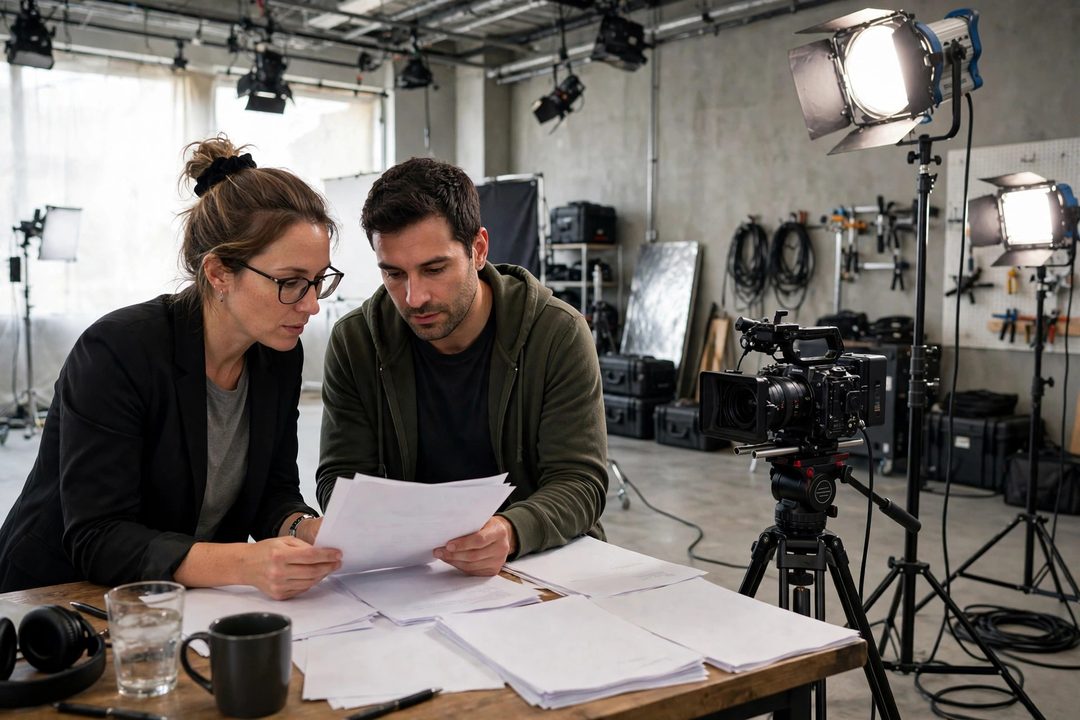
Because a video ad is a promise about what a buyer will receive. Envy Creative never makes AI generated videos. Every video is filmed with real actors and your real product in a 5,000 square foot studio in Simi Valley, California. When the product appears in the first seconds, in a real hand, at real scale, the viewer can judge size, quality, and use in a way a voiceover alone cannot deliver.
How long should each line in a video ad script be?
Keep spoken lines short enough to land in one breath, roughly 8 to 12 words for the hook and 12 to 18 words for proof lines. At a normal speaking pace, a 30 second ad holds about 75 to 85 words in total, and a 60 second ad holds about 150 to 160 words.
How do you test two different hooks without reshooting the whole ad?
Film both hooks in the same session and edit two versions that share the same proof section. Changing only the first 5 seconds gives you a clean test: same actor, same product, same offer, different opening. That tells you which opening your buyers respond to before you scale spend.
Plan for that test when you price the work. At Envy Creative, pricing is flat rate with no hidden fees, from $150 for Amazon product videos, from $199 for studio quality UGC and vertical ads, and from $500 for commercial explainer videos, within an overall range of $150 to $5,000 or more depending on scope. Turnaround runs 7 to 30 days overall, with UGC in 7 business days, commercials and long form videos in 21 days, and Amazon product videos in 30 days, and rush delivery is available. Revisions are included, and online use is included on YouTube, social, your website, Amazon, CTV and OTT, and paid ads.
Start your next script by writing 5 possible first lines, then score each one on clarity, specificity, and whether the product can be shown while it is said. Keep the winner, film a second hook as your test variant, and build the proof section around one claim you can demonstrate. Then talk to Envy Creative with your product, your buyer, and the opening line you want to test. You will get a script written to be filmed, shot with real actors, and edited with captions and platform versions included, so the first 5 seconds do the job they are meant to do.
Frequently asked questions
What is the best opening line for a video ad?
The best opening line names a specific problem or outcome for a specific buyer and can be shown on screen at the same time. Avoid starting with your brand name or a general claim. Start with what changes for the buyer, in words they would use themselves.
How many words should a 30 second video ad script have?
A 30 second script should have about 75 to 85 spoken words. That leaves room for pauses, product shots, and captions that viewers can actually read. If the draft runs long, cut benefits before you cut proof.
Should a UGC ad script be written word for word?
Write the hook and the call to action word for word, and give the actor clear talking points for the proof section. That keeps the key claims accurate while the delivery stays natural, which is why UGC style ads feel like a recommendation instead of a commercial.