How to Test Video Ad Creative: A Practical System for Brands
A practical system for testing video ad creative, changing one variable at a time across hooks, presenters, and formats to find winners you can repeat and scale.
The fastest way to test video ad creative is to change one variable at a time, starting with the hook, then the presenter, then the format, while keeping the offer and call to action fixed. That system tells you what caused a lift, instead of leaving you with a winning video you cannot repeat. In a scan of 102,998 ecommerce videos posted between October 6 and November 16, 2026, only 24.2 percent reached at least twice the usual views for their account, which shows why guessing is expensive and structured testing matters.
What should you test first in a video ad?
Test the hook first, because the opening seconds decide whether anyone sees the rest of the message. Keep the same actor, product, and setting, and film 3 different openings for the same script: a problem statement, a direct result claim you can prove, and a common mistake. Run them with equal budgets for 48 to 72 hours and judge them on hold rate, click through rate, and cost per purchase, not views alone. If one hook wins clearly, lock it and move to the next variable. Changing the hook, the actor, and the music at once feels faster, but it leaves you with no lesson you can reuse.
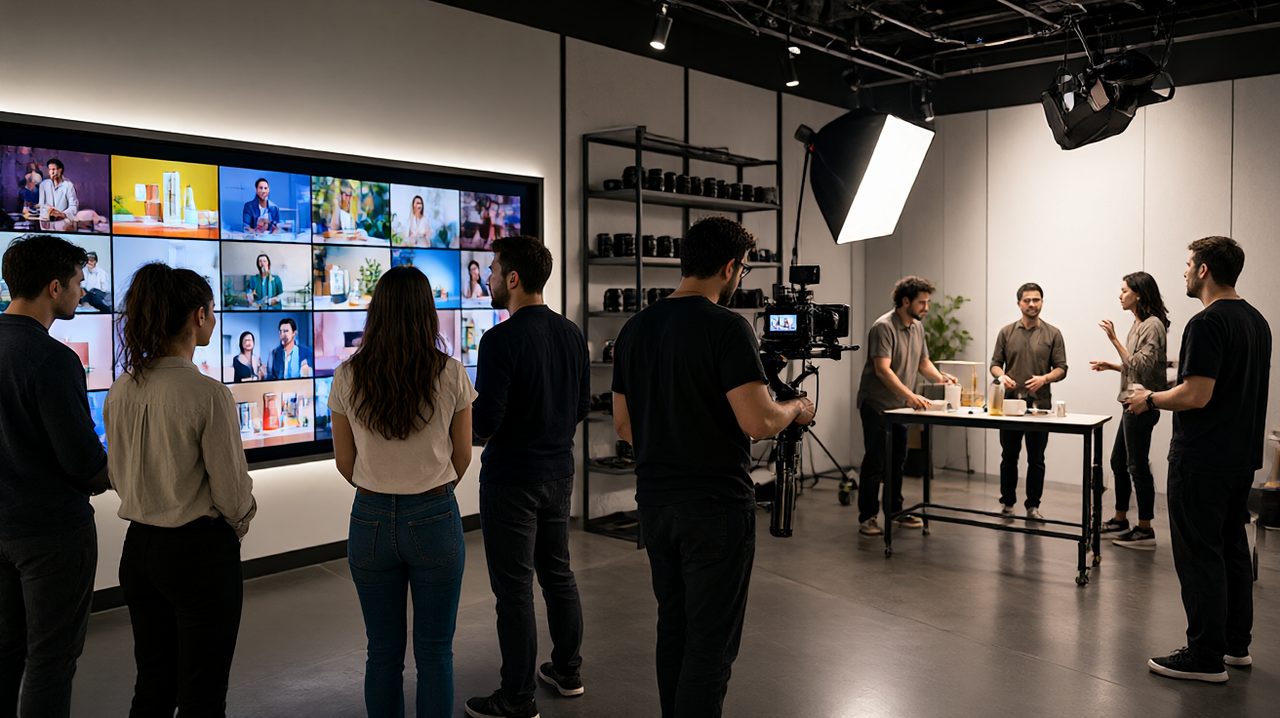
Next, test the presenter with the winning hook. A founder, a customer style testimonial, and a confident studio presenter can deliver the same lines and produce very different trust levels. Real facial expressions, real handling of the product, and real room tone signal that a real business stands behind the claim. Envy Creative works this way from its 5,000 square foot studio in Simi Valley, California, filming variations in a single session so brands can compare presenters without paying for 3 separate shoots. You can see how that model works at Envy Creative.
How many variations do you actually need to find a winner?
You do not need dozens of unrelated videos. You need a small, disciplined set: 3 hooks, 2 presenters, and 2 formats, which gives you 6 to 8 finished ads. Format matters more than most teams expect. In that same 2026 scan, beauty unboxings broke out 41.9 percent of the time, while product demos led in home categories at 28.4 percent, so the best format depends on your category. For a physical product, test an unboxing against a hands on demo. For software, test a screen led walkthrough against a presenter led explainer. For a service, test a testimonial against a direct to camera breakdown of the process.
Volume still matters, but only when it is organized. The IAB projects United States creator ad spend will reach 37 billion dollars in 2025, up 26 percent in a year, and about a third of brands say finding the right creators is their biggest hurdle. A test matrix solves it, because every video has a job: prove or disprove one idea. Keep a simple sheet with the variable, hypothesis, spend, and result. After 2 rounds, patterns emerge, such as which claim buyers repeat in comments.
How do you run a creative test without wasting budget?
Set the rules before you spend. Give each variation the same audience, placement, and daily budget, and set a kill threshold in advance, for example pausing any ad that spends twice your target cost per purchase with no sale. Let winners run at least 3 to 5 days to confirm the result is stable before you scale budget by more than 20 percent at a time. Save every losing video. A hook that failed for one product often works for another.
Production planning is the other half of saving money. Film all variations on the same day, with the same lighting and product setup, and only change the planned variable. That keeps costs flat and results clean. At Envy Creative, packages include scriptwriting, professional talent and locations, editing, motion graphics, captions, and multiple aspect ratios, with flat rate pricing and no hidden fees. Pricing starts at 150 dollars for Amazon product videos, 199 dollars for studio quality UGC and vertical ads, and 500 dollars and up for commercial explainer videos, with an overall range of 150 to 5,000 dollars and up. With over 5,000 videos delivered for more than 2,000 brands and a 38 percent return client rate, that bundled approach makes repeat testing affordable.
What should you do with a winning video ad?
Do not just raise the budget and hope. First, remake the winner with deliberate upgrades: a tighter edit, clearer captions, and versions cut for each placement, including vertical for TikTok and Reels, wide for YouTube, and square for feeds. Second, film the next round while the winner is still fresh, using its hook on your next product. Third, confirm usage rights cover paid ads, your website, Amazon, and connected TV, with broadcast licensed separately. Winning creative fades with repetition, so produce its replacement while it is still performing.
How long should a creative test run?
Most small budget tests need 48 to 72 hours per variation for a clear read on hold rate and clicks, and 3 to 5 days to confirm a purchase winner. If traffic is low, extend the test rather than raising budgets sharply.
What makes a UGC ad convert better than a polished commercial?
It usually comes down to believability and speed. A UGC style ad shows a real person using the product in the first seconds, names a specific problem, and gives one clear reason to buy. A polished commercial can win for brand launches and higher priced offers, which is why testing both formats against the same offer beats choosing one style on opinion alone.
How much does it cost to produce test variations?
Planning variations as one production is far cheaper, because talent, set, and lighting are shared. At Envy Creative, UGC and vertical ads start at 199 dollars and Amazon product videos start at 150 dollars, so a structured test set costs far less than unrelated videos ordered one by one.
Start your next round with a plan, not a pile of ideas. Write the hypothesis, film the variations together, and let the numbers pick the winner. If you want a partner that scripts, films, and edits the full test set with real actors, talk to Envy Creative and turn one good idea into creative you can scale with confidence.