How to Make Self-Promotional Videos Without Losing Buyer Trust
Self-promotional videos can clarify your value and accelerate sales, but constant brand-first messaging creates skepticism and fatigue. This guide shows business leaders how to balance promotion with useful insight, credible proof, and audience-centered storytelling.
Self-promotion is not the problem. Your audience knows your company wants to sell something, and pretending otherwise can feel stranger than simply being direct. The trouble begins when every video behaves like a commercial, every executive sounds rehearsed, and every customer problem becomes a convenient runway for another product pitch.
Used thoughtfully, promotional video can clarify what you do, demonstrate confidence, and help buyers justify a decision. Used relentlessly, it can make a capable company appear insecure. The difference is not how polished the footage looks. It is whether the viewer receives something valuable before being asked to believe a claim.
Why promotional video works in the first place
Video gives buyers a fast way to assess your people, product, and point of view. A well-made piece communicates tone, competence, and attention to detail in a way a page of corporate copy rarely can. It can also simplify an unfamiliar service, show a product in context, or turn an abstract promise into visible evidence.
This is especially useful in B2B sales, where several stakeholders may need to understand the same offer. A concise video can give a marketing lead, finance director, and executive sponsor a common story to discuss. Current B2B research from Edelman and LinkedIn also emphasizes the influence of useful thought leadership on less-visible members of buying groups. Those people may never attend your first sales call, but they can still affect whether the deal advances.
Promotion therefore has a legitimate job. Buyers need to know why your offer matters, where it fits, and why they should trust you. The backfire starts when the brand treats its own message as more important than the buyer's decision.
The moment confidence starts looking like vanity
I have sat through creative reviews where the original idea was sharp, human, and useful. Then came the additions: another logo shot, three more product benefits, a longer founder introduction, and a closing line approved by six departments. By the final cut, the viewer had disappeared from the story.
That pattern usually produces one or more warning signs:
- The company is the hero while the customer is merely an audience.
- Claims such as innovative, leading, or best in class appear without proof.
- Executives explain what they want to say instead of answering what buyers want to know.
- Every social clip ends with the same hard sales request.
- Customer stories devote more time to the vendor than to the customer's transformation.
- The production looks expensive, but the message could belong to any competitor.
Buyers are not offended by branding. They are frustrated by wasted attention. If a video takes ninety seconds to deliver ten seconds of substance, the audience learns that future content from the company is probably skippable.
Put the buyer's tension ahead of your solution
A stronger promotional structure begins with a situation the audience recognizes. Show the operational bottleneck, missed opportunity, internal disagreement, or emotional pressure surrounding the decision. Let viewers see themselves before introducing your company.
For example, a software video could open with a revenue team reconciling conflicting forecasts before a board update. A manufacturing partner could show an engineer discovering a tolerance issue shortly before launch. A professional services firm could dramatize the moment a leader realizes that growth has outpaced the company's processes.
The brand still belongs in the story, but it enters as a capable guide. This creates a more persuasive sequence: recognizable problem, meaningful consequence, credible approach, visible evidence, and appropriate next step. Promotion becomes the natural result of helping rather than an interruption disguised as help.
If your team needs a campaign built around that balance, talk with Envy Creative about custom video content. A focused creative process can protect the buyer's perspective while still giving sales and leadership the clarity they need.
Replace adjectives with things a camera can prove
Video is an evidence medium. Use it to show rather than decorate. Film the product performing the difficult task. Capture the customer describing the situation in their own language. Show the specialist who actually does the work. Include the process, environment, or constraint that makes your expertise believable.
This matters because buyers tend to evaluate company-produced material with healthy skepticism. Forrester's guidance on customer-centric content notes that product-centered thought leadership can be perceived as biased, unoriginal, and irrelevant. A video earns authority when it teaches viewers something they could use even if they do not buy immediately.
Useful forms of proof include:
- A specific before-and-after result with enough context to understand it.
- A product demonstration based on a real use case rather than ideal conditions.
- A candid customer account that includes the initial concern or obstacle.
- A behind-the-scenes look at how quality is controlled.
- An expert explanation of a costly mistake and how to avoid it.
- A clear statement about who is not a good fit for the offer.
That final option is surprisingly powerful. Saying who should not buy signals confidence and helps qualified prospects recognize themselves faster.
Build a content mix that earns the right to sell
One promotional video rarely causes brand fatigue. Repetition without increasing value does. A healthy video program gives different pieces distinct roles across the buyer journey.
Use educational videos to answer recurring questions and reframe important problems. Use thought leadership to offer a defensible point of view. Use customer stories to transfer credibility from your company to people who have experienced the work. Use demonstrations to reduce uncertainty. Use culture and behind-the-scenes pieces to humanize the team. Then use direct promotional videos when there is a relevant offer, launch, event, or conversion opportunity.
There is no universal ratio, but a practical editorial test is simple: if someone removed your logo, would the video still be worth watching? Not every asset must pass that test. A product announcement naturally centers the brand. Across the full program, however, buyers should encounter far more insight and proof than applause.
Give polished production a human pulse
Authenticity does not require shaky footage or improvised messaging. It requires recognizable human behavior. A polished film can still include pauses, specificity, humor, disagreement, and genuine reactions. In fact, strong production should make those moments easier to notice.
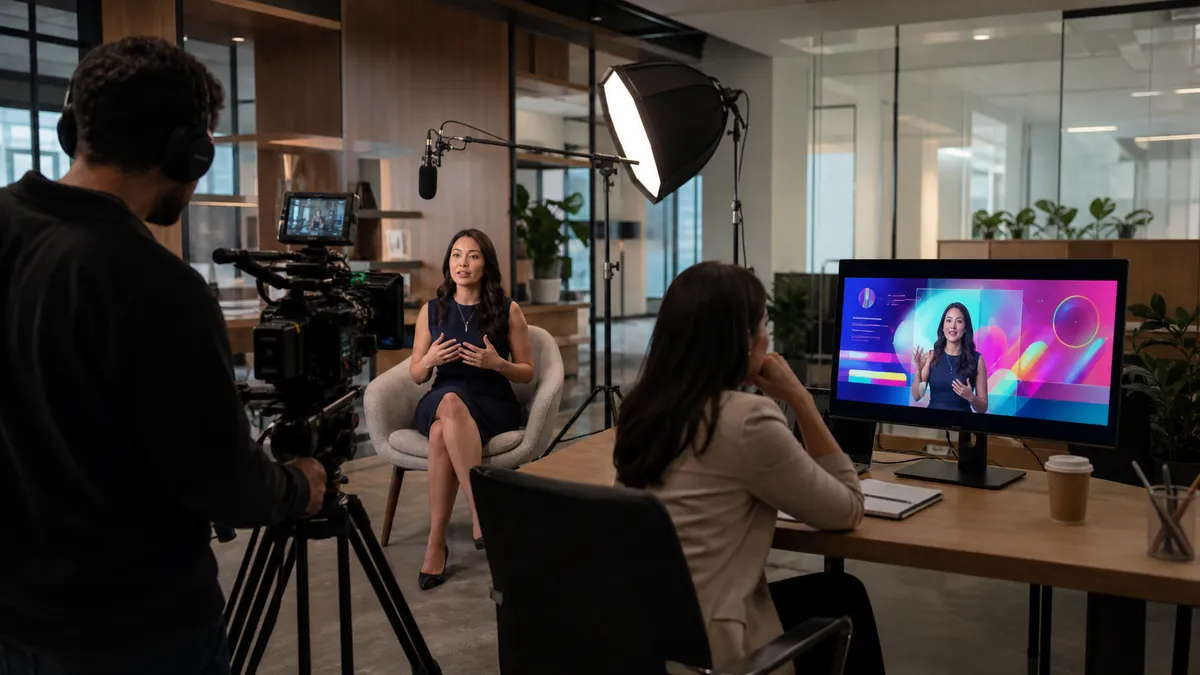
A skilled director helps contributors speak naturally without abandoning the campaign strategy. Thoughtful lighting and sound create confidence. Deliberate editing removes repetition without sanding away personality. The goal is not to make real people act like professional presenters. It is to create conditions in which they can communicate clearly as themselves.
This is where experienced production delivers value beyond technical execution. Envy Creative approaches business video as a persuasion and storytelling problem first. The camera, crew, casting, design, and post-production choices all serve the audience's understanding. That produces work that feels premium without becoming corporate wallpaper.
Measure trust signals, not just immediate clicks
A strong video may influence a deal without receiving the final conversion credit. Buying groups share links privately, revisit customer stories, and use product videos to brief internal stakeholders. Evaluate performance using a combination of attention, sales, and qualitative signals.
Watch completion rates, meaningful engagement, repeat viewing, branded search, qualified site visits, sales-cycle questions, influenced opportunities, and how often sales teams voluntarily use an asset. Ask prospects which video helped them understand the offer. Ask account executives where buyers remain uncertain. Those conversations often reveal more than a dashboard full of impressions.
Most importantly, audit the emotional pattern of your library. Does the audience repeatedly see your company celebrating itself, or do they see a useful partner helping people make better decisions?
Make the brand memorable for the help it provides
Self-promotional video works when the promotion is supported by relevance, proof, and restraint. Tell people what you offer, but first demonstrate that you understand what is at stake. Show confidence, but leave room for customer voices and honest complexity. Invest in polish, but preserve the moments that make people believable.
The best brand video does more than make a company look impressive. It makes the buyer feel informed, understood, and ready to take a sensible next step. To create a campaign that earns attention while moving real business goals forward, connect with Envy Creative for custom video content.