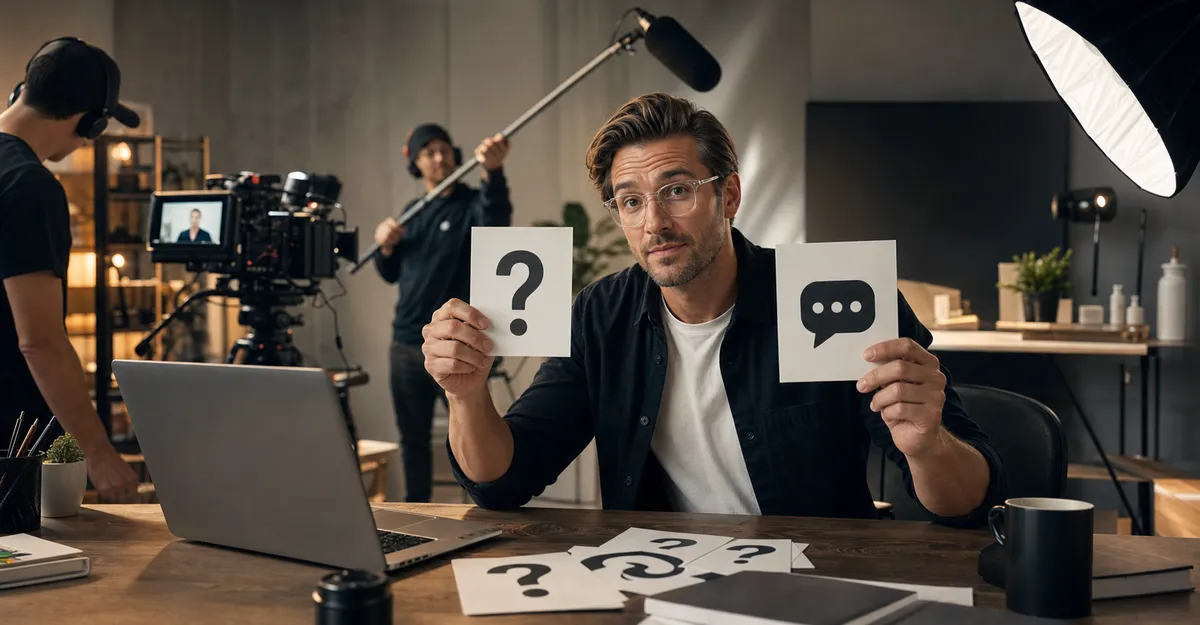
Creative Director answers brand marketing questions from the Internet
A practical creative director Q&A on brand marketing, video strategy, content performance, trust, AI, short-form video, and how businesses can stop making content that looks busy but says nothing.
Brand marketing questions online tend to sound simple until you try to answer them with real money on the line. Should we post more? Should we make a brand video? Is TikTok still worth it? Why do our ads get clicks but no sales? Can AI make our content for us? Why does our competitor look bigger than us when we know their product is not better?
Those are not beginner questions. Those are the questions business owners, marketers, founders, and sales teams ask when they know the old answer of "just make more content" is not good enough anymore.
So here is the practical creative director answer: brand marketing works when your audience can quickly understand who you are, what you solve, why you are believable, and what they should do next. Video helps because it can show proof faster than almost any other format, but only when it is planned with strategy. A pretty video with no point is still just expensive wallpaper.
What is brand marketing supposed to do?
Brand marketing should make the market remember and trust you before the sales conversation starts. It is not only a logo, tagline, color palette, or one polished campaign. Those things can help, but they are not the whole job.
The real job is clarity. If a buyer lands on your website, watches your video, sees your ad, or checks your social feed, they should be able to answer four questions quickly:
- What does this company do?
- Who is it for?
- Why should I believe them?
- What is the next step?
If your content cannot answer those questions, the market fills in the blanks for you. Usually with something unhelpful, like "looks expensive," "seems generic," or "I will come back later," which is buyer code for absolutely not coming back later.
Do brands need more content or better proof?
Most brands do not have a content shortage. They have a proof shortage.
They have posts, reels, carousels, ads, blog updates, landing pages, and a video from three brand refreshes ago. But the content does not prove anything specific. It does not show the process. It does not explain the product. It does not answer buyer objections. It does not make the team feel real. It does not give sales a useful asset to send after a call.
That is why a strong video strategy starts with buyer questions instead of content formats. Before deciding whether something should be a commercial video, explainer video, TikTok, vertical ad, product video, FAQ video, or customer story, ask what the buyer needs to believe.
Do they need to believe the product is easy to use? Show the product working. Do they need to believe the company is credible? Show the people, process, results, and environment. Do they need to believe the offer is different from a cheaper option? Show the difference in planning, production quality, editing, and business outcome.
That is the difference between making content and building evidence.
Is video still worth it when everyone is making video?
Yes, but the bar has moved. Video is no longer special just because it exists. A brand gets value from video when the idea, hook, pacing, visuals, audio, and call to action all work together.
Short-form video can create attention. Long-form video can build trust. Product videos can reduce uncertainty. Explainer videos can make a complicated offer feel simple. Commercial videos can give a campaign a strong creative anchor. Behind-the-scenes content can make the company feel more human. The mistake is treating all of those as interchangeable.
A 15-second vertical ad and a two-minute homepage video should not have the same job. One earns the next second. The other helps a serious buyer understand the brand. If you ask one asset to do every job, it usually does none of them well.
At Envy Creative, that is why planning matters before anyone touches a camera. With 5,000+ completed projects, an in-house team, a production studio, pro cinema cameras, lighting, audio, scripting, editing, product video experience, commercial video experience, and vertical content production, the point is not to make a file. The point is to create assets that help the business move.
Can AI replace brand marketing?
AI can help with ideas, outlines, drafts, repurposing, and research. It can also help a mediocre brand make mediocre content faster, which is less exciting than the software demo made it sound.
The problem is that brand marketing is not only output. It is judgment. What should the audience feel in the first five seconds? What proof is missing? What does the product need to show on camera? What should be cut because it sounds impressive internally but means nothing to a buyer? What is the simplest story?
AI can assist with those questions, but it does not replace the need for real brand truth, real customers, real visuals, real production choices, and a creative point of view. If your market already thinks everything sounds the same, using more generic AI copy is not the escape hatch. It is the elevator down.
Why do some brands look bigger than they are?
They make their proof visible.
A smaller company can look more established when its website explains the offer clearly, its videos show polished process and real outcomes, its social content answers useful questions, and its ads look like they belong to a company that has done this before.
That does not mean pretending to be huge. It means removing the signals that make buyers nervous: bad sound, vague messaging, inconsistent visuals, thin product pages, confusing calls to action, and a content feed that looks like five different interns fought over the calendar.
Production quality matters because buyers use it as a shortcut. They may not know your internal process, but they can feel whether the brand looks prepared. Good lighting, clear audio, confident scripting, intentional editing, and useful visuals all say, "We have done this before." That feeling reduces friction.
What should brands make first?
Start with the highest-friction buyer question. Not the trendiest format. Not the video your competitor made. Not the idea someone saw on LinkedIn and described in a meeting with the phrase "we should do something like this," which is how many content calendars enter witness protection.
Pick one question that repeatedly slows down sales or creates confusion. Then make one strong asset around it.
For some brands, that is a product explainer. For others, it is a homepage brand video, a direct-response ad, a founder story, a customer proof video, a set of short-form educational clips, or a product demo designed for sales follow-up.
Once the core asset exists, repurpose it intelligently. Turn the best answers into vertical clips. Pull stills for ads. Use the transcript for landing-page copy. Build FAQ content from the questions. Create shorter edits for email, retargeting, and sales. A good shoot should not produce one lonely video sitting in a folder named final_final_revised. It should produce a useful content system.
How should a brand judge whether marketing is working?
Do not only judge brand marketing by immediate clicks. Clicks matter, but brand marketing also improves the things that happen before and after the click: recognition, trust, recall, sales confidence, product understanding, ad quality, landing-page performance, and the speed at which someone decides you are worth considering.
Useful signs include better qualified leads, stronger sales conversations, lower confusion, more direct traffic, higher video completion on the right assets, better ad engagement, stronger landing-page behavior, and more people using the same language your content has been teaching them.
The most practical test is simple: can your content help a real buyer make a better decision? If the answer is no, it may still be content, but it is not doing much marketing.
The creative director answer
Brand marketing is not about making your company louder. It is about making it easier to understand and easier to trust.
That is why the best video content is not just attractive. It is specific. It answers real questions. It shows proof. It gives buyers language. It makes the brand feel credible before a sales rep ever joins the call.
If your brand has a strong offer but your content feels scattered, vague, or forgettable, the fix is not more noise. The fix is a clearer strategy and better evidence.
Envy Creative helps brands plan and produce custom video content that looks polished, explains the offer, supports marketing and sales, and gives the brand assets it can use across web, ads, social, email, and sales conversations. If your team is ready to turn brand marketing questions into useful video content, visit Envy Creative and start with the question your buyers ask most.