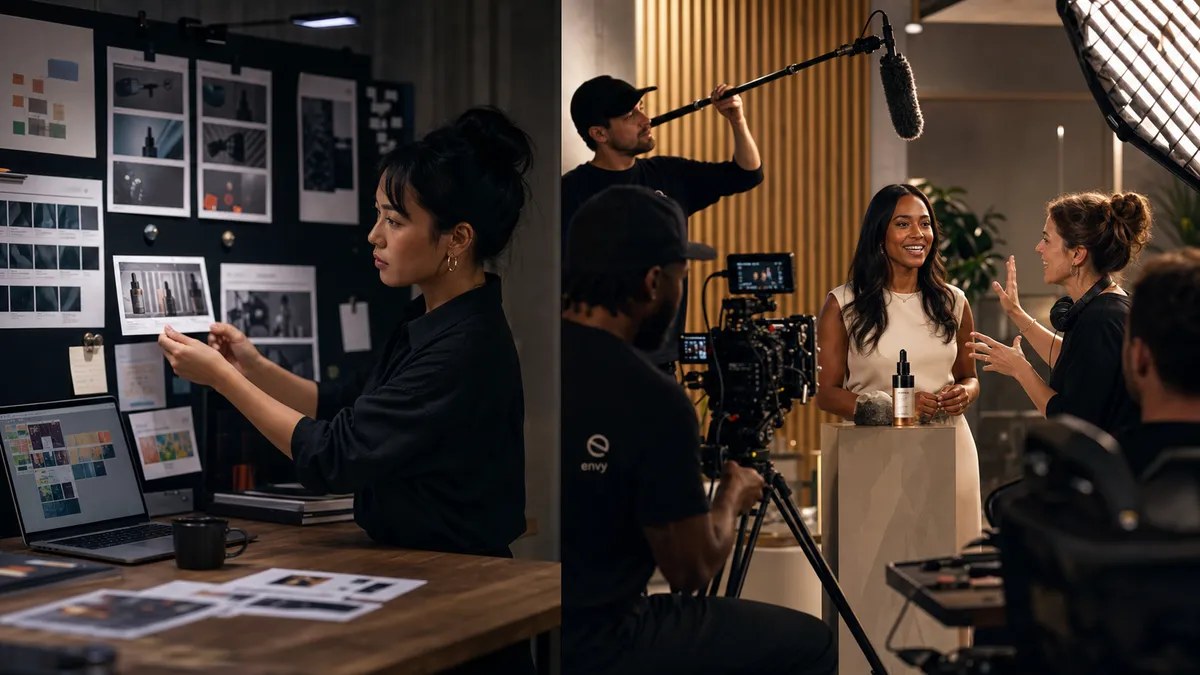
Agentic vs. Generative Video AI: Why Real Video Still Wins Buyers
Agentic video AI and generative video AI can both help marketing teams move faster, but they solve different problems. Generative AI makes video assets from prompts, while agentic AI plans and executes parts of the workflow. For brand trust, product accuracy, emotional performance, and high-stakes campaigns, human-led video production still creates the stronger business asset.
AI video is moving fast enough that even smart marketing teams are starting to mix up the vocabulary. One platform promises text-to-video magic. Another says an AI agent can plan, edit, publish, test, and optimize your campaign. Both sound powerful. Both can be useful. And both can quietly waste budget if you expect them to replace the judgment of a real creative team.
At Envy Creative, we’re not anti-AI. We use smart tools where they help strategy, planning, and production move faster. But after years of producing product videos, brand films, commercials, ecommerce content, and social campaigns, one thing is still obvious: the brands getting the best results are not replacing human video with AI. They’re using AI to support better human-led production.
The Difference in One Sentence
Generative video AI creates new video or visual assets from prompts, images, text, or existing footage. Agentic video AI tries to manage tasks and workflows by planning steps, using tools, making decisions, and executing actions toward a goal.
That distinction matters because the buying decision is different. If you need quick visual exploration, generative AI might help. If you need workflow support, agentic AI might help. If you need a video that makes buyers trust your company, understand your product, and feel confident enough to take action, you still need human creative direction, real production craft, and a team that knows how to shape a story.
What Generative Video AI Actually Does
Generative AI is the category most people think of first. According to Google Cloud, generative AI can create content such as text, images, audio, code, and videos. In a video marketing context, that can mean creating a short clip from a prompt, animating a still image, generating concept frames, building a synthetic spokesperson, or visualizing a scene before a shoot.
Tools like Runway have pushed this category forward quickly, especially around consistency, camera movement, and image-to-video generation. That is genuinely useful for creative development. A team can test a mood, sketch a scene, or build a rough visual reference without booking a studio for every idea.
Where it gets risky is when a company treats a generated clip as a finished brand asset. AI video can still struggle with product details, hand movement, natural expressions, packaging accuracy, continuity, legal clarity, and the tiny human details that make a viewer believe what they’re watching. A rough concept can be imperfect. A homepage hero video, paid ad, product launch film, or investor-facing brand piece cannot feel almost right.
What Agentic Video AI Changes
Agentic AI is less about making one clip and more about getting work done. IBM describes agentic systems as AI that can perceive information, reason, set goals, make decisions, execute actions, and adapt based on feedback. In video marketing, that might look like an agent that analyzes a product page, drafts a creative brief, writes hook variations, organizes footage, creates edit notes, builds a publishing checklist, or summarizes campaign performance.
That can be a major productivity win. A small marketing team can use agentic AI to reduce repetitive admin, structure versioning, and keep campaign tasks moving. The key is to understand what it is doing. It is coordinating and accelerating parts of the process. It is not automatically becoming a strategist, director, producer, editor, and brand guardian.
An agent can suggest a shot list. It cannot stand on set and know that the founder’s second take felt more honest. It can organize performance data. It cannot decide that the opening line should be quieter because the product already carries visual authority. It can generate options. It cannot own taste.
The Buyer Problem Most AI Videos Miss
Business video is not just content. It is proof. Your audience is looking for signals that your company is credible, your product is real, your team knows what it’s doing, and your promise can be trusted. That proof often lives in the details: eye contact, lighting, pacing, product texture, natural body language, authentic environments, and the confidence of a real person explaining something clearly.
There is also a growing trust issue around synthetic media. Adobe reported that consumers are increasingly questioning whether voices are AI-generated, while human voices remain the most trusted. That same emotional pattern shows up in video. People may not always identify why a synthetic performance feels off, but they often feel the gap.
I’ve been on shoots where the best moment in the final cut was not in the script. It came after the client relaxed, laughed, and said the thing they actually meant. That kind of moment is hard to prompt because it is not an output. It is a relationship, a room, a director listening closely, and a person finally feeling comfortable enough to be real.
If your next video needs to earn trust instead of just fill a content slot, talk to Envy Creative about custom video content. The right production plan should protect the human moments that make buyers believe you.
Where Each Approach Belongs
The practical question is not whether AI is good or bad. The question is where it belongs in the production chain.
- Use generative video AI for mood boards, early concept frames, rough visual tests, placeholder scenes, and low-risk creative exploration.
- Use agentic video AI for brief organization, production checklists, asset versioning, transcript summaries, campaign task management, and performance reporting.
- Use human production for brand-defining videos, product accuracy, founder stories, testimonials, commercials, sales enablement, launch films, and paid campaigns where credibility affects revenue.
That split keeps AI in the right role. It supports the team, but it does not become the whole strategy.
Why Human-Led Production Still Wins
Human video production wins because it gives your brand control. A real crew can shape lighting, lens choice, wardrobe, sound, art direction, location, blocking, performance, product handling, and edit rhythm around your actual business goal. Those decisions are not decorative. They are how a video communicates quality before anyone reads a line of copy.
Human production also gives you specificity. AI tends to average. Strong brand video gets particular. It captures the way your product feels in someone’s hand, the hesitation your sales team hears before a buyer commits, the exact objection a customer needs answered, and the emotional tone your category requires.
That is especially important for B2B and high-consideration purchases. A buyer may watch your video before booking a call, sharing your product internally, or comparing you against a cheaper competitor. If the video feels generic, the company feels generic. If the video feels precise, credible, and human, it can shorten the distance between curiosity and trust.
The Smartest Future Is Hybrid
The best video teams will absolutely use AI. They will use it to brainstorm, organize, test, summarize, version, and speed up repetitive work. They will use generative AI to explore visual possibilities and agentic AI to keep complex workflows moving. But they will keep humans in charge of strategy, emotion, brand fit, and final judgment.
For decision-makers, that is the real takeaway. Generative video AI can make clips. Agentic video AI can manage steps. Human creative direction turns video into a business asset.
If you’re planning a homepage video, product launch, ecommerce campaign, customer story, or paid social library, start with the business outcome. What should the buyer believe after watching? What should they feel in the first five seconds? What proof do they need before they click, book, buy, or share the video with their team?
Once those answers are clear, AI can support the process. But the strongest work still comes from real people making deliberate creative decisions around real products, real buyers, and real moments.
Envy Creative helps brands build that kind of video, from concept and scripting to production, editing, and campaign-ready deliverables. For custom video content that feels human, polished, and built to convert, visit Envy Creative.