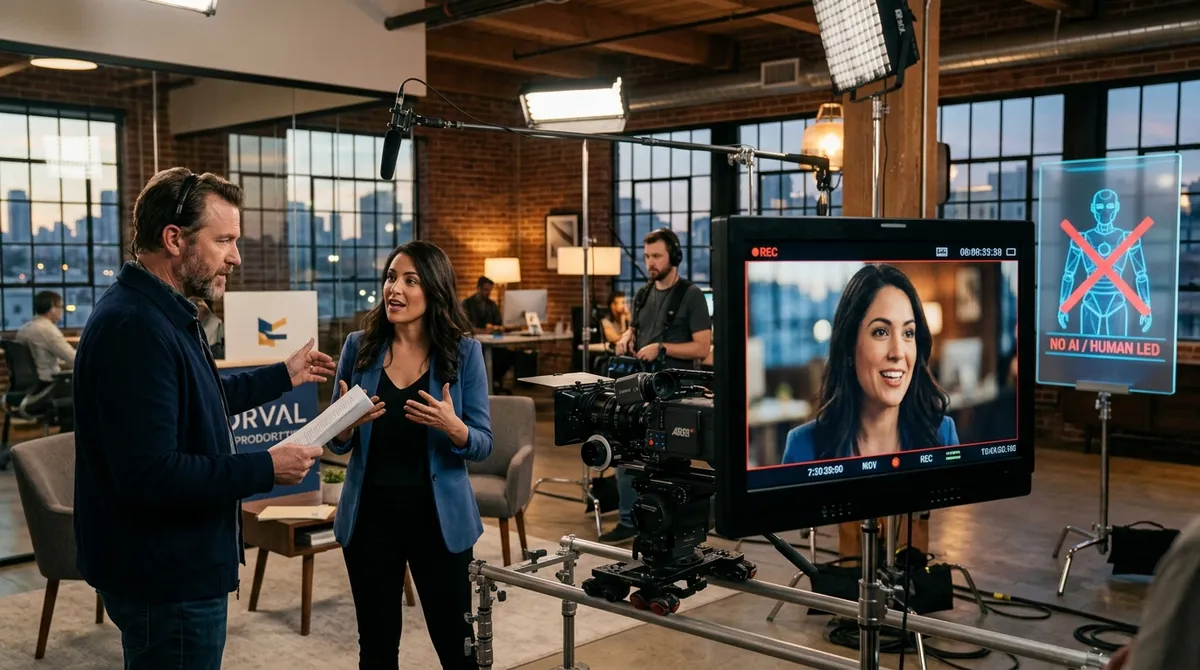
Beyond the Algorithm: Why the Academy's New AI Rules Prove Human Stories Drive Real Business Results
The Academy of Motion Picture Arts and Sciences has banned AI actors and AI-written scripts from Oscar eligibility. Discover what this historic decision means for your business video marketing strategy and why human-led storytelling remains the ultimate driver of customer trust and brand growth.
The Day Hollywood Drew a Line in the Sand
I was sitting in our studio last week, watching our crew set up a complex three point lighting arrangement for a client's brand story video, when the news broke. The Academy of Motion Picture Arts and Sciences had officially updated their eligibility rules, declaring that AI actors and AI written scripts are banned from Oscar eligibility. Only roles performed by real human actors and screenplays written by people will qualify for awards consideration going forward. While this decision sent shockwaves through Hollywood, my immediate thought went to the business leaders and marketing executives we collaborate with every day. If the world's most prestigious storytelling institution is drawing a hard line in the sand, what does that mean for your brand's video marketing strategy?
Why the Academy's Stance Matters to Your Bottom Line
The reality is that Hollywood is reacting to a truth that experienced marketers have known for decades. True emotional connection cannot be synthetically engineered. For decision makers in growing businesses, the temptation of generative artificial intelligence is obvious. The promise of push button video creation, synthetic avatars speaking perfect scripts, and zero production costs sounds like a shortcut to scale. But as the Academy's decision highlights, when you strip human authorship and real human performance from the creative process, you strip away the very element that makes the medium work. In a crowded digital landscape, your customers do not want to be lectured by a digital puppet; they want to connect with a real human being.
The Trap of the Synthetic Actor
Let us look closer at why the Academy took this stance. The updated rules specify that acting categories are strictly limited to roles demonstrably performed by humans with their consent, and screenplays must be human authored. This is not just a protection of jobs. It is a defense of the craft. When you watch a powerful film, you are connecting with the vulnerability of the actor, their subtle micro expressions, and the unique human perspective of the writer. The exact same rules apply to business video marketing. If you are trying to convince a B2B buyer to trust you with a six figure contract, or trying to persuade a consumer to purchase your premium product, you need to establish trust. A synthetic, robotic avatar reading a generic script will not build that trust. In fact, it often achieves the opposite, signaling to your audience that your brand is willing to cut corners on its own message.
When a business chooses to automate its creative content entirely, it enters a race to the bottom. Because AI tools are widely accessible, anyone can generate a basic marketing video in seconds. The result is a flood of lookalike, soundalike videos that fail to capture attention. To stand out, you must go in the opposite direction. You must double down on authentic, human led storytelling. If you want to create videos that capture real human emotion and drive actual results, check out the custom video content services at Envy Creative today. We focus on bringing human stories to life, ensuring your brand stands out in a sea of automated noise.
AI as a Tool versus AI as the Creator
Now, it is important to note what the Academy did not ban. They did not ban the use of AI as a tool. Filmmakers are still free to use machine learning and automated software in technical categories like visual effects, sound design, and color grading. The distinction they are making is critical: AI is an excellent assistant, but a terrible creator. At our agency, we embrace technology to make our workflows more efficient. We use platforms like Frame.io to collaborate with clients and speed up review times, and we use modern editing software that utilizes smart tools to automate tedious tasks. But when it comes to the core script, the creative direction, and the actors on screen, we rely entirely on human talent. AI should be used to polish the presentation, never to replace the human soul of the message.
The Core Ingredients of Human Creativity
Consider the scripts that win customers. An AI script generator can analyze millions of data points and output a structurally correct marketing script. But what it cannot do is draw from personal experience, understand local cultural nuances, or inject genuine humor and irony. A human writer knows how it feels to solve a frustrating business problem, and they can translate that feeling into a script that makes your target audience nod along in agreement. When you hire professional writers and directors, you are not just paying for words on a page; you are paying for the empathy, experience, and creative intuition that turns a passive viewer into a loyal brand advocate. Here is what makes human-crafted stories perform better:
- Genuine Empathy: Real writers speak to human pain points from personal experience.
- Nuance and Humor: Subtle cultural references and jokes require a human mind.
- Unique Perspectives: Humans challenge conventions, while AI only repeats patterns.
The performance is where the magic happens. A real actor brings an unpredictability, a warmth, and a charisma that cannot be replicated by an algorithm. They know how to deliver a line with just the right amount of sincerity or humor. They can read the energy of the room and adapt their performance under the guidance of a seasoned director. This level of nuance is what builds trust with your audience. When a potential client sees a real human speaking passionately about your product or service, they see a reflection of your company's values. They see that you value quality, authenticity, and human connection enough to invest in a real production.
The ROI of Real Human Production
Consider the channels where your video marketing lives. Whether you are running campaigns on social platforms or building a community on YouTube, the algorithms are designed to reward viewer engagement and retention. What keeps a viewer watching? It is not the novelty of a computer generated voice. It is the pacing, the humor, the authentic struggle, and the ultimate resolution of a human story. When you look at the return on investment of high quality video, you have to look beyond the initial cost of production. A cheap, fully automated AI video might cost very little to make, but if it fails to convert viewers, its actual ROI is zero. On the other hand, a custom, professionally produced video that resonates with your target audience will generate leads, build brand equity, and drive sales for years.
The Path to Authentic Brand Video
The Academy's new rules are a clear wake up call for businesses everywhere. The future of video marketing does not belong to the brands with the most complex algorithms, but to the brands that tell the most authentic human stories. In a world increasingly saturated with cheap, synthetic content, human authenticity is your ultimate competitive advantage. Ready to elevate your brand with authentic, high impact stories? Partner with the experts at Envy Creative to bring your vision to life.