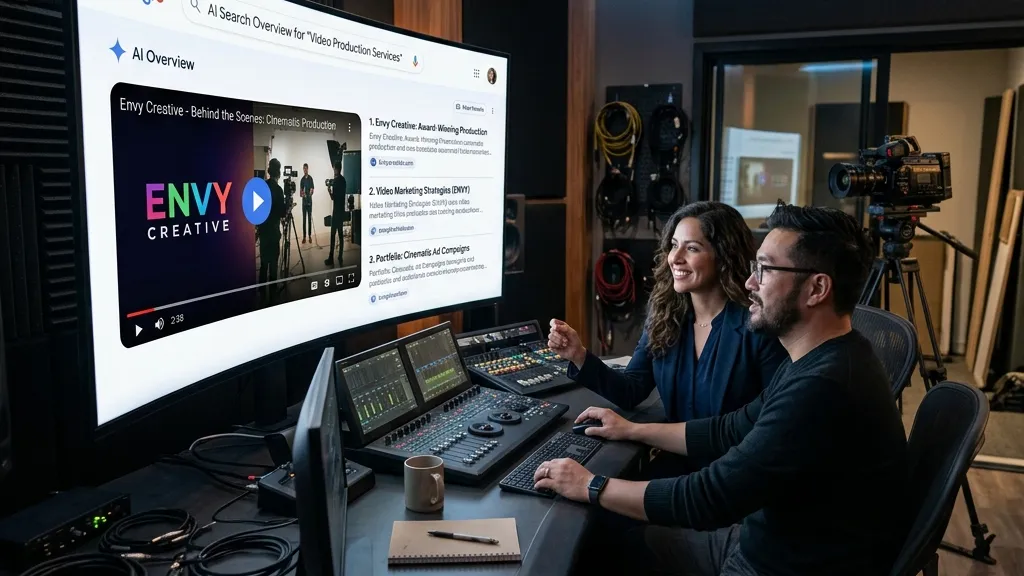
Winning the AI Search Update: How to Get Your B2B Marketing Video Cited in Google's Link-Rich Overviews
Google's latest AI search update introduces more prominent, descriptive links within AI Overviews. For B2B businesses, this makes video SEO a game of source optimization. This post breaks down how the new link-rich AI search works, why professional production is required to meet Google's strict quality standards, and the exact steps to get your marketing videos cited directly in search results.
A few weeks ago, I was sitting in our studio with a B2B software founder who was incredibly proud of his company's video library. They had spent months recording dry product screen shares and uploading them to their channel. But when we searched for their primary product questions, Google's new AI Search Overviews bypassed their videos entirely and linked to a competitor's polished, structured tutorial instead. He looked at me and asked why Google was ignoring their videos when they had put so much effort into creating them. The truth is, traditional search engine optimization is changing fast, and we are entering the era of Generative Engine Optimization, where AI search engines do not just rank content, they cite it.
The Shift From Page Rankings to AI Citations
Google's latest update to its AI-generated search results is a game-changer for B2B brands and marketers. In the past, AI Overviews were seen as traffic killers because they provided quick answers that kept users on the search page without clicking through. Now, Google is inserting more prominent, descriptive links directly within these AI-generated responses. For businesses that invest in professional video marketing, this is a massive opportunity to secure prime real estate at the very top of search results. But to get your marketing video cited, you need to understand how these AI algorithms read your content.
Let's look at the mechanics of this update. Google's AI search experience is designed to provide greater transparency by making it easier for users to click through to original sources. The more prominent and descriptive links are designed to encourage users to explore your content further. Because AI models increasingly view video content as high-authority, they often select it to provide a more comprehensive answer than text alone. This means your primary objective is no longer just ranking on page one, it is being cited as a trusted source within the AI Overview itself.
How Google's AI Reads and Selects Video Content
To get your marketing videos seen in AI search, you must first understand how Google's AI reads and selects video content. AI search engines do not watch videos the way humans do. They digest them as structured text and data. If your video is just sitting on a webpage without proper context, the AI will ignore it. To make your marketing video visible to the AI, you must feed it structured information that is easy to crawl.
First, accurate transcripts are non-negotiable. Don't rely on auto-generated captions, which are frequently full of embarrassing errors. Google compares video transcripts with the audio to determine credibility and relevance. By providing a clean transcript with at least ninety-five percent accuracy, you make it easy for the AI to parse your message, extract key quotes, and associate your video with the specific search queries it answers.
Second, you must implement VideoObject schema markup on the page where your video lives. This structured data tells the search crawler exactly what your video contains, including the title, description, thumbnail URL, and upload date. Without this markup, Google has to guess what your video is about, and in the world of AI search, guessing means losing.
Third, you must master chapters and timestamps. The AI search engine often pulls a specific ten-second segment to answer a user's question directly, rather than sending them to the start of a ten-minute video. By structuring your video with clear, keyword-rich chapters, you allow Google to index these specific segments as direct answers to conversational queries.
If this technical optimization sounds complicated, you are not alone. Most B2B marketing teams do not have the time or tools to handle the intersection of search tech and high-end video production. That is why it is critical to work with a partner who understands both sides of the coin. Talk to Envy Creative about building custom video content that is built for the AI search era. We handle the strategy, production, and technical setup so your video is ready to be cited.
The Multimodal SEO Strategy for Modern Brands
The next step is building a multimodal SEO strategy. AI engines look for pages that combine multiple formats to provide the best possible user experience. A page that has a great video, clear text, and high-quality images has a much higher chance of being featured in AI Overviews than a page with just text or just a video. Your video needs to be embedded in a context-rich page that answers the query in text as well. This creates a multimodal authority signal that the AI cannot ignore.
Why DIY Video Tools Fail the Search Test
We also need to talk about why DIY video tools fail the search test. Many businesses try to cut corners by using generic DIY template tools or automated AI video generators. While these might produce a file quickly, they lack the original insights, polished presentation, and technical optimization needed to rank. Google's quality algorithms, known as experience, expertise, authoritativeness, and trustworthiness, actively filter out generic content. A polished video featuring real experts, real production value, and unique insights will always win the citation game.
Let's consider how Google's quality standards affect your brand's reputation. When a decision-maker at a company sees your video cited in an AI Overview, they are not just looking for an answer, they are evaluating your brand. A shaky phone video with a busy text overlay and a weak hook will fall apart without the platform propping it up. On the other hand, a well-produced video with intentional framing, a confident on-camera presence, clean audio, and a visual story that builds toward a clear value proposition will hold their attention and drive action.
Actionable Video SEO Best Practices for Business Owners
To ensure your content has the best chance of appearing in these link-rich AI search results, you must follow a disciplined set of production and optimization steps. Here is the checklist we use for our clients at Envy Creative:
- Define clear search intent: Before you turn on the cameras, identify the exact question your target customer is asking. Build the entire video around answering that question clearly and concisely in the first thirty seconds.
- Embed the video prominently: Place the video at the top of your webpage, above the fold. Google prioritizes pages where the video is the primary focus of the content, not tucked away in a sidebar.
- Optimize the page load speed: A heavy, unoptimized video player that slows down your page will hurt your rankings. Use high-performance video hosting and lazy-load players where appropriate.
- Verify your transcripts: Take the time to edit auto-generated transcripts manually. Check for brand name spelling, technical terms, and clear punctuation so the AI search engine reads them perfectly.
Future Proofing Your Brand Video Assets
To monitor your performance under this new system, you should monitor your visibility using tools like Google Search Console to see where your video impressions are coming from. The data will tell you which search queries are bringing traffic to your pages and which videos are being indexed successfully. This feedback loop is essential for refining your content calendar and production priorities over time.
The search environment will continue to evolve, but the demand for authoritative, engaging video will remain constant. By preparing your assets with clean schema, accurate transcripts, and high-production values today, you ensure your marketing budget pays dividends for years to come. Stop waiting for the search results to slide. Connect with the Envy Creative team today to start building video assets that dominate the search landscape.