Video GEO: How Brands Earn ChatGPT Visibility With Better Content
ChatGPT visibility is not won by stuffing prompts or publishing generic AI content. Current AI search data points toward trusted brand mentions, crawlable pages, YouTube visibility, transcripts, structured video pages, and proof-rich content. For business leaders, professionally produced video can turn expertise into searchable assets that work across ChatGPT, Google, YouTube, sales, and paid media.
A few years ago, the question was simple: how do we rank on Google? Now the better question is: how do we become the brand AI tools confidently recommend when a buyer asks for options, comparisons, examples, or advice?
That is where video gets interesting. Not because ChatGPT is watching your entire brand film like a creative director with a latte. It is not that romantic. Video works because it creates a cluster of evidence around your brand: YouTube presence, transcripts, captions, embedded pages, expert commentary, product proof, customer language, branded mentions, and quotable explanations. When those assets are crawlable and useful, they give AI systems more substance to work with.
The Data Point Most Brands Are Missing
Recent AI visibility research from Ahrefs found that YouTube mentions had one of the strongest correlations with AI visibility across ChatGPT, Google AI Mode, and AI Overviews, with a reported correlation around 0.737. That does not mean uploading a random video magically ranks you in ChatGPT. Correlation is not a button. But it does strongly suggest that brands with visible, structured video ecosystems are easier for AI search experiences to recognize, compare, and mention.
Profound also analyzed large volumes of ChatGPT citation behavior and found that when ChatGPT cites YouTube, it often points to a specific video rather than just a channel. That matters for businesses. A strong video library is not just awareness content anymore. It can become a searchable body of proof that helps answer buyer questions before your sales team ever gets involved.
ChatGPT Ranking Is Really Answer Eligibility
Most people use the phrase rank on ChatGPT because it is familiar. I get it. We all need a shorthand. But the better mental model is answer eligibility. ChatGPT does not show ten blue links in the classic way. It builds an answer from sources, patterns, entities, and context. Your job is to make your brand easy to understand, easy to verify, and easy to cite.
OpenAI’s official crawler documentation says OAI-SearchBot is used to surface websites in ChatGPT search features. If your site blocks that crawler, your best video landing page may never become part of the answer set. So yes, creative matters. But technical access matters too.
- Make your video pages crawlable: Check robots.txt, firewall rules, indexability, canonical tags, and page speed.
- Publish supporting text: Add summaries, transcripts, FAQs, speaker names, product details, and buyer-focused takeaways.
- Use video structured data: Follow Google Search Central guidance for video pages, even if your goal includes AI search.
- Build entity clarity: Use consistent brand, service, category, location, client type, and outcome language.
Why Video Helps AI Trust You
Business buyers do not want another vague blog post saying solutions are innovative. AI tools are starting to reflect that impatience. The content that travels well is specific: a founder explaining how a product works, a customer describing a measurable result, a subject matter expert breaking down a process, or a product demo that solves a real buying objection.
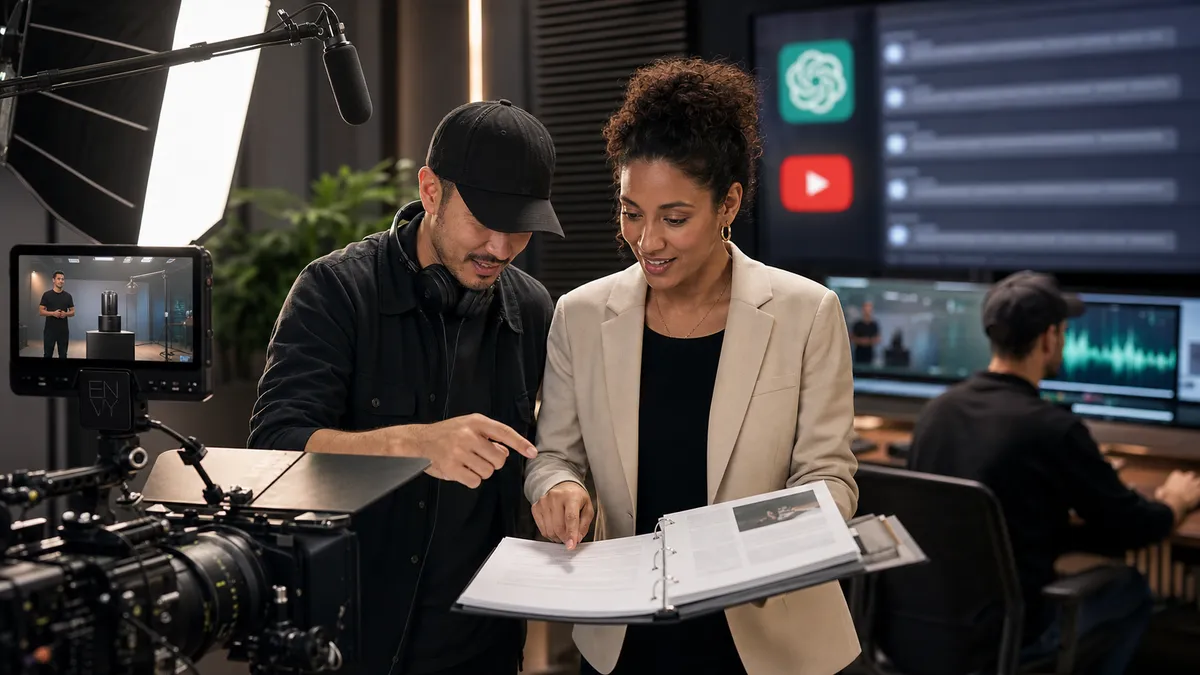
On set, we see this constantly. A client will start with a broad claim like we help teams save time. Then, once the camera is rolling and we ask better questions, the useful answer appears: we cut onboarding from three weeks to four days because the training videos show every handoff in context. That second version is the asset. It is memorable for humans and legible for AI.
If your team wants that kind of proof built into the production plan from the start, talk with Envy Creative about custom video content. The win is not just a prettier video. It is a reusable evidence engine for search, sales, ads, email, and AI answers.
The Video Assets That Actually Pull Weight
Not every video format has the same GEO value. For ChatGPT and AI search, the best assets answer questions that decision-makers already ask. Think less viral teaser and more useful proof.
- Expert explainers: Give clear answers to high-intent questions in your category.
- Product demos: Show what the buyer gets, how it works, who it is for, and what problem it solves.
- Customer stories: Tie the brand to a real business outcome, not just a testimonial smile.
- Comparison videos: Explain tradeoffs honestly so AI systems can associate your brand with buyer evaluation moments.
- Process videos: Show how your team delivers quality, which is especially useful for premium services.
- Short clips from long shoots: Turn one production day into a library of searchable answers.
YouTube Is Only Half the Play
YouTube gives your video a powerful discovery surface, but do not leave the whole strategy there. Host or embed important videos on your own site too. Create a dedicated page for each major video, then surround it with useful text. Add a short summary, clean headings, a transcript, a few question-led sections, and links to related service pages.
YouTube captions and chapters also help structure the asset. Official YouTube guidance supports adding captions and timestamped chapters, which gives viewers and systems more context. For B2B video, chapters can map directly to buying questions: problem, process, proof, pricing factors, timeline, and next steps.
The GEO Checklist for Video Teams
If I were reviewing a brand’s video library for ChatGPT visibility, I would not start by asking whether the camera was expensive. I would ask whether the footage creates usable answers.
- Does the video name the problem clearly? Use the buyer’s language, not internal product slang.
- Does it include credible proof? Numbers, customer context, workflows, before-and-after details, and named expertise all help.
- Is there a transcript? AI systems need text paths into video content.
- Is the landing page useful without watching? Summaries and takeaways help both humans and crawlers.
- Are related pages connected? Link the video page to service pages, case studies, and relevant resources.
- Is the brand mentioned consistently elsewhere? Branded web mentions, reviews, PR, partner pages, and category lists all reinforce authority.
What Not to Do
Do not chase ChatGPT with thin AI-written pages wrapped around stock footage. That is the fastest way to create content nobody trusts. Do not publish one hero video and expect AI visibility to follow. Do not hide the best information inside a video with no transcript. And do not make every video a sales pitch. Answer engines need answers.
The brands that will win are the ones that treat video like structured expertise. They will plan each shoot around buyer questions, capture clear claims, build multiple cuts, publish useful pages, and distribute the clips where people and AI systems can encounter them.
The Practical Bottom Line
Video can help you rank in ChatGPT, but not as a trick. It works when it makes your brand more findable, more understandable, and more credible across the web. Current data points toward YouTube visibility, brand mentions, crawlable pages, citations, and structured supporting content. Great production gives you the raw material. Smart SEO, AEO, and GEO turn that material into discoverable proof.
If your brand needs video that does more than look polished, partner with Envy Creative for custom video content. We can help you plan, shoot, and package the kind of expert-led video assets that buyers trust and AI search can actually understand.