AI Video Marketing Mistakes That Make Brands Look Less Trustworthy
AI generated video is now common in marketing, but speed alone is not a strategy. The brands that win use AI selectively for planning, versioning, and testing while protecting the human proof, craft, and credibility that buyers need before they take action.
AI video has moved from novelty to normal at a speed that makes most marketing teams feel both excited and slightly cornered. I get it. When a tool promises ten videos by lunch, it is tempting to ask why anyone would still plan a shoot, book talent, direct interviews, or sweat over lighting. But after years of watching business buyers respond to video, one thing keeps showing up: people can forgive simple, but they rarely forgive fake.
The Real Problem Is Not AI, It Is Lazy AI
Current advertising research points in the same direction. AI generated creative is becoming common, especially in video, and buyers are testing it across ads, social, training, and sales enablement. At the same time, consumer trust is fragile. Audiences are getting better at spotting synthetic content, and platforms are adding disclosure rules in sensitive categories. The lesson for business leaders is not to avoid AI completely. The lesson is to stop treating AI output as a substitute for strategy, proof, and taste.
The strongest video marketing still answers a human question: can I trust this company to solve my problem? If your AI generated video makes the product feel generic, the testimonial feel invented, or the brand feel like it is hiding behind automation, it can work against the sale. That is where strategies backfire.
Backfire 1: Replacing Proof With Synthetic Polish
One of the fastest ways to weaken a campaign is to use AI to create fake-feeling proof. A synthetic spokesperson can explain a feature. A generated scene can mimic a customer outcome. A polished avatar can read a script. But business buyers are not only listening for information. They are evaluating credibility, confidence, and risk.
If a real founder, customer, technician, sales lead, or product expert can say it better, show them. Real proof does not need to be messy, but it should feel earned. A customer story filmed with good direction, clean audio, and thoughtful editing carries signals AI cannot easily fake: hesitation, conviction, context, and lived detail.
Use AI for ideation, outline development, rough cut planning, and versioning. Do not use it to fabricate trust. That shortcut can make a premium brand feel like a low-effort affiliate ad.
Backfire 2: Scaling Before The Message Is Sharp
AI makes it easy to produce volume. That is useful only if the core message is already right. If your positioning is muddy, AI will help you distribute the mud faster.
We see this a lot with companies that want twenty short videos before they have one clear sales story. The result is a pile of assets that all say roughly the same thing in different words: we are innovative, we save time, we help teams grow. None of that is wrong, but it is not enough to move a skeptical buyer.
Before scaling, define the buyer pain, the moment of urgency, the proof point, the offer, and the emotional reason to care. Then decide which videos deserve AI assisted repurposing and which ones deserve custom production. That order matters.
Backfire 3: Using AI Where Emotion Has To Feel Earned
Some categories can tolerate synthetic visuals better than others. A quick internal explainer, a placeholder storyboard, or a simple social test may be fine. But if the goal is to build emotional connection, especially around a founder story, customer transformation, luxury product, recruiting campaign, or high-ticket service, fake warmth is risky.
Recent public reactions to AI generated holiday ads showed how quickly audiences can reject work that feels hollow, uncanny, or cost-cutting dressed up as innovation. The comments are rarely about render settings. They are about feeling. People notice when a brand tries to borrow nostalgia, sincerity, or community without putting real people behind it.
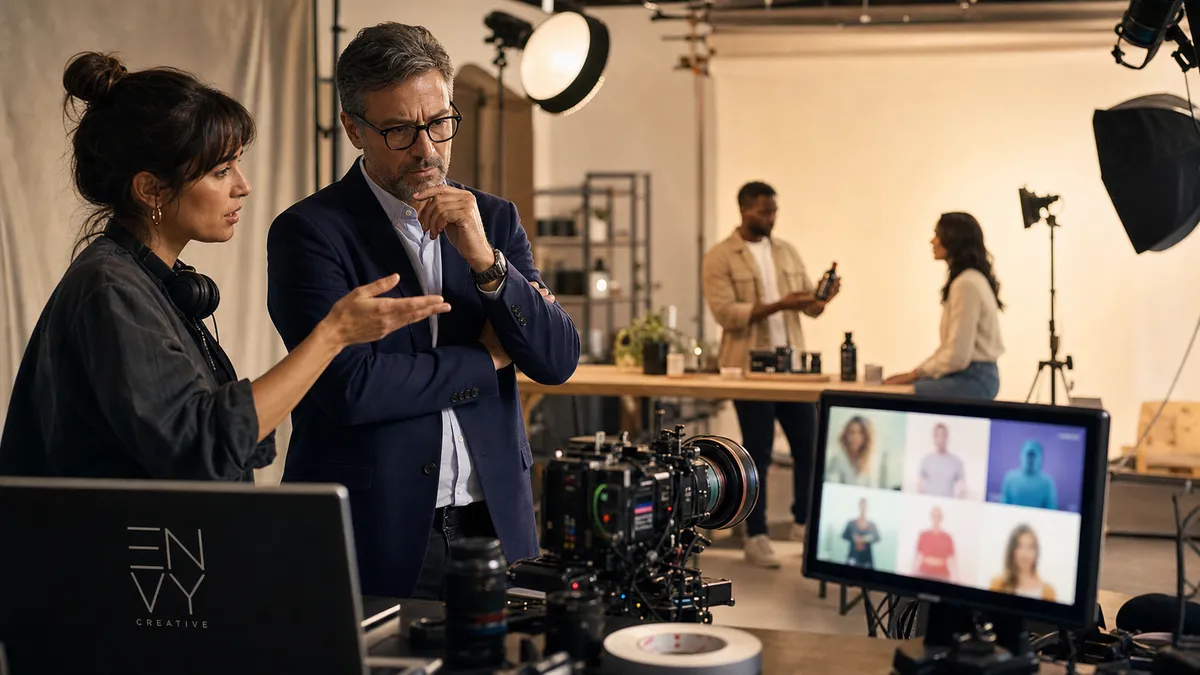
That is where production craft earns its keep. Lighting, pacing, casting, art direction, location, lens choice, and performance all shape whether a viewer feels invited in or kept at a distance.
Backfire 4: Forgetting Disclosure And Platform Risk
Disclosure is becoming a bigger part of the AI video conversation. Google Ads has synthetic content rules in political advertising, and broader advertising bodies are pushing transparency frameworks as AI content becomes more common. The FTC has also continued to scrutinize deceptive AI claims and marketing practices.
For business video, the practical takeaway is simple: do not make viewers guess what is real when that distinction affects trust. If you use AI voices, synthetic people, cloned likenesses, or altered footage, build a review process. Legal, brand, and performance teams should know what was generated, what was licensed, what was approved, and where it will run.
This is not just about avoiding trouble. Clear standards make teams faster because everyone knows the guardrails before production begins.
Backfire 5: Making Every Channel Look The Same
AI tools can flatten creative taste. A LinkedIn thought leadership clip, a YouTube pre-roll ad, a homepage brand film, and a sales follow-up video should not feel like the same asset with different captions. Each channel has a job.
- Paid social: win attention quickly and test hooks.
- Website video: build trust and clarify value.
- Sales enablement: answer objections and reduce perceived risk.
- Customer stories: prove outcomes through real voices.
- Recruiting video: make culture feel specific, not generic.
AI can help create variations, but the strategy should decide what each version needs to do. Otherwise, the campaign becomes a wallpaper pattern: everywhere, but easy to ignore.
Where AI Actually Helps Video Marketing
The smart move is not human versus AI. It is human direction with AI assistance. At Envy Creative, the best uses tend to happen before and after the shoot: audience research, script angles, shot list exploration, edit version planning, caption drafts, thumbnail concepts, localization, and performance testing.
The camera still matters when the buyer needs to see the real product, real team, real facility, real customer, or real result. If your campaign needs that level of credibility, partner with Envy Creative for custom video content that combines strategy, production, and conversion-minded editing instead of hoping a prompt can carry the whole brand.
A Better Playbook For Decision Makers
If your team is considering AI generated video, use this filter before greenlighting the campaign.
- Is the viewer being asked to trust a claim? Use real proof whenever possible.
- Is the video representing a person, customer, or outcome? Be careful with synthetic substitutes.
- Is the goal premium positioning? Do not let cheap production signals undercut the price.
- Will this run as paid media? Check platform rules and disclosure requirements before launch.
- Does the idea still work if the viewer knows AI was used? If not, rethink it.
I have been in enough edit reviews to know that the small things often decide whether a video feels credible. A glance between a founder and customer. The texture of a real product in real light. A line delivered slightly imperfectly, but with complete conviction. Those moments are hard to generate because they are not decoration. They are evidence.
Make AI Serve The Brand, Not Replace It
AI generated video is not automatically cheap, deceptive, or ineffective. Used well, it can make strong creative teams faster and more experimental. Used poorly, it can make a serious company look careless. The difference is whether AI is serving a strategy or pretending to be one.
For decision-makers, the safest path is to protect the parts of video that create trust: real people, real proof, sharp messaging, strong direction, and a clear reason for the viewer to care. Let AI speed up the support work. Let production carry the moments that matter.
If your next campaign needs to sell a high-value product, explain a complex offer, or make buyers believe in your brand, talk to Envy Creative about custom video content. We will help you use the right tools without letting the tools flatten the story.